
The Anatomy of an Essential oil Blend

Where botanical science meets the alchemist's art.
There is something extrordinary about opening a bottle of essential oil. Within that little vessel lies the aromatic essence of a plant–the story of soil, sunshine, climate, chemistry, and the remarkable botanical world.
But what happens when we bring those individual essences together?
How does the brightness of a citrus oil find harmony with the earthy depths of Vetiver? Why does a single drop of an unexpected botanical sometimes transform an entire creation? And what separates a thoughtfully crafted blend from simply mixing a few oils that smell wonderful?
Welcome behind the blending bench at Northern Prairie Botanicals.
Today, we're exploring the anatomy of an essential oil blend, from its aromatic architecture and botanical chemistry to the techniques that transform individual oils into a beautifully balanced creation. We'll also walk through a simple recipe you can try in your own home.
Because while there is certainly magic in the making, there is also extraordinary amount of science.
Why do we blend essential oils?
Blending begins with intention.
Sometimes we're creating a fragrance that evokes a particular place or memory. Other times, we're developing an aromatic experience designed to complement meditation, relaxation, focus, or a cherished daily ritual.
And sometimes, we're simply curious about what happens when two very different botanicals meet.
Every essential oil has its own aromatic character and chemical composition. Some are bright and immediately recognizable, while others reveal themselves slowly. Certain oils are powerful enough to dominate an entire composition with a single drop.
The art lies in finding the right relationship between them.
A well-constructed blend doesn't necessarily contain dozens of ingredients. In fact, some of the most beautiful aromatic compositions contain only three of four carefully selected oils.
The goal isn't complexity for its own sake. It's harmony.
The aromatic architecture: Top, Middle, and Base notes
Just as a musical composition contains different instruments, and essential oil blend contains different aromatic voices.
In traditional perfumery, these are organized into three general catagories: top, middle, and base notes

Top Notes: The first impression
Bright, lively, and often fleeting, top notes are the first aromas we notice when encountering a blend. Sweet Orange, Lemon, Grapefruit, and Pepperming are all familiar examples. These aromatic introductions capture our attention before gradually giving way to the composition beneath them.

Middle Notes: The heart of the blend
Middle notes provide much of a blend's personality, connecting its brighter opening to its deeper foundation. Lavender, Geranium, Rosemary, and many floral and herbal essential oils occupy this aromatic territory. These are often the botanicals that give a composition its recongizable character.

Base Notes: The foundation
Deep, rich, and persistant, base notes provide warmth, depth, and longevity. Vetiver, Patchouli, and certain woods and resins lend structure to a blend and often remain noticeable long after its lighter aromas have faded. They're the foundation upon which the rest of the composition rests.
These catagories aren't rigid rules. Some essential oils bridge more that one category, and their behavior can change depending on the other ingredients in a formulation.
Part of becoming a skilled blender is learning to recognize those relationships.
The Science Behind the Art.
Essential oils aren't single aromatic substances. They're complex mixtures of naturally occuring chemical constituents.
Depending on the botanical, these may include monoterpenes, sesquiterpenes, alcohols, esters, aldehydes, keytones, and numerous other compounds.
These constituents help determine an oil's fragrance, volatility, chemical behavior, and safety considerations.
For example, limonese contributes significantly to the bright aroma of many citrus oils, while linalool and linalyl acetate help give true Lavender it's familiar floral character.
Understanding essential oil chemistry gives the blender another valuable tool.
It helps us anticipate how ingredients might complement one another, recognize potential safety concerns, and understand why two oils from seemingly similar plants can smell remarkable different.
Howevernm combining oils doesn't automatically make their effects stronger or establish therapeutic synergy. Each formulation deserves to be evaluated according to its actual ingredients, concentrations, intended use, and available scientific evidence.
The chemistry informs our decisions. Our noses help guide the artistry.
Behind the blending bench: How a blend comes to life
At Northern Prairie Botanicals, blending begins long before the first deop reaches the bottle.
First, establishing the intention
Every blend needs a starting point. What am I trying to create? A bright, cheerful aroma? A deeply grounding composition? Something gentle and comforting?
The intended aromatic experience helps guide the selection of botanicals.
Second, Selecting the botanicals
This is where quality matters.
Botanical identity, extraction method, supplier documentation, and chemical composition all deserve consideration.
Two bottles labled Frankincense, for example, may represent different Boswellia species, each possessing its own aromatic characteristics.
Whenever available, GC/MS reports provide additional insite into an oil's chemical composition and can help inform ingredient selection and quality assessment.
Third, Building the aromatic structure
With our botanicals selected, it's time to condiser how their individual aromas will interact.
I begin with a small experimental formula, considering the balance between top, middle, and base notes.
A dominant botanical may need only a tiny amount. A quieter ingredient might require a larger proportion to make its presence known.
Fourth, Measuring and documenting
Where creativity meets good manufacturing practice
Every formulation should be recorded so that it can be accurately reproduced.
Working by weight with a suitable precision scale allows for consistent measurements, particularly when developing products intended for future production.
Each change is documented. That wonderful little adjustment that transforms an ordinary blend into something exceptional shouldn't be left to memory. (especially mine)
Fifth, Resting and evaluating
A freshly combined blend may smell different after several hours or days.
As it's individual components mingle and its more volatile constituents begin to evaporate during evaluation, different aspects of the composition become apparent,
I like to revisit a new creation rather than make every adjustment immediatly.
Sometimes the blend needs another drop of something unexpected. Sometimes it needs nothing more that patience.
Let's Make a Blend: Woodland Orchard
Now that we've explored the principals, let's put them into practice.
This simple three-oil composition demonstrates the relationship between a bright citurs, resinous warmth, and a grounding woody foundation.
A simple DIY diffuser recipe
Woodland Orchard
Golden citrus meets the quiet embrace of the forest
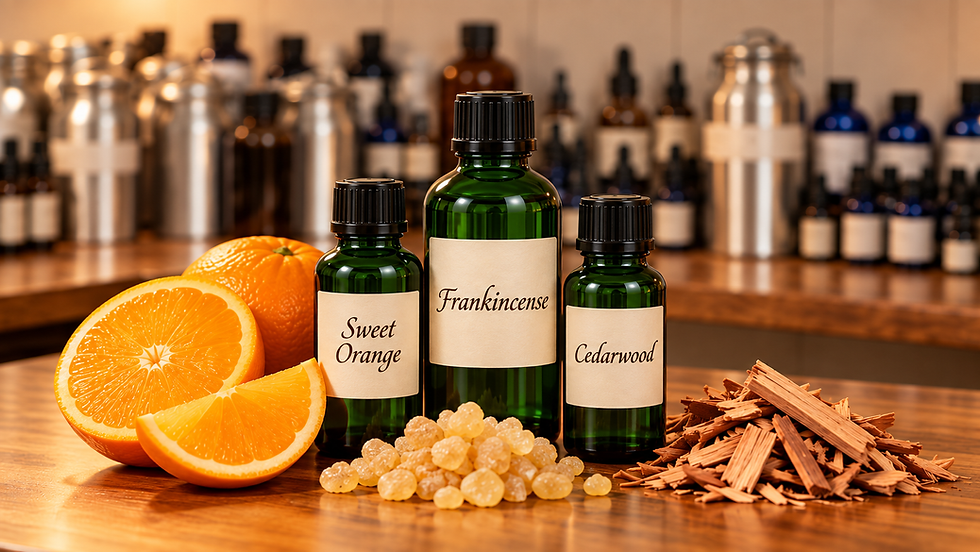
Sweet Orange (citrus sinensis) 3 drops
Frankincense (Boswellia carterii) 2 drops
Cedarwood (Cedrus atlantica) 1 drop
The Aromatic Experience
Sweet Orange introduces the composition with cheerful, golden brightness. Frankincense adds a beautiful resinous heart, while Cedarwood provides a warm, woody foundation
The result is an inviting aromatic combination reminiscent of sunlight filtering through an autumn forest.
Your Blending Ritual
Familiarize yourself with each essential oil individually before combining them. Scent strips help you get to know your oil.
Add the oils to a small, clean glass bottle.
Secure the cap and gently rotate the bottle to combine. Do not shake.
Smell your creation using an aroma strip or the bottle opening. My recommendation-scent strip.
Allow it to rest for several hours before evaluating again.
Use an appropriate nimber of drops in your diffuser according to the manufacture's instructions; this six-drop recipe may need to be reduced for smaller diffusers.
Safety: This recipe is intended for diffusion, not ingestion or undiluted skin application, Diffuse intermittently in a ventilated room. Use particular caution around children and pets, expecially cats, birds, and amimals with respiratory conditions. Always provide pets with the option to leave the area.
The Importance of Safety
Natural doesn't automatically mean harmless.
Essential oils are highly concentrated aromatic materials, and safe use requires an understanding of proper dilution, exposure, ingredient-specific precautions, and the intended method of application.
Some essential oils can cause skin irritation and sensitization. Certain expressed citrus oils are phototoxic, while others contain constituents that warrant additional restrictions or special consideration.
A blend intended for a diffuser isn't necessarily appropriate for a bath, facial oil, massage product, or application around children.
Professional aromatherapy blending involves evaluating these consdierations before formulation is approved for its intended use.
Respect for the botanicals includes respect for their potency.
Becoming a Botanical Alchemist
You don't need an enourmous essential oil collection to begin discovering the art of blending.
Start with a few familiar botanicals. Spend time exploring each one individually, paying attention to how its aroma changes over time. Each essential oil has their own top, middle, and base notes.
Keep a journal of your experiments, Note what works, what doesn't , and which unexpected combinations spark your curiosity.
And don't be discouraged with something doesn't turn out quite as you imagined. Every experiment is an opportunity to learn something new about the oils you're working with.
The more familiar you become with your materials, the more confidently you'll begin to recognize their individual voices.
The Magic in the Making
An essential oil blend is moe than a collection of aromatic ingredients.
It's a meeting of botanical histories, chemical complexities, creative intention, and the careful hands of the person bringing them together.
Some blends are simle and understated. Others require numerous experiments before their individual elements finally find harmony.
And occasionally, everything comes together in a way you couldn't have anticipated when you selected that very first bottle.
Tha't the beauty of blending,
Science provides the foundation. Experience develops the skill. Creativity gives each formulation its own distinctive character.
And somewhere between the laboratory and the imagination, we discover the magic in the making,
–Northern Prairie Botanicals
Comments